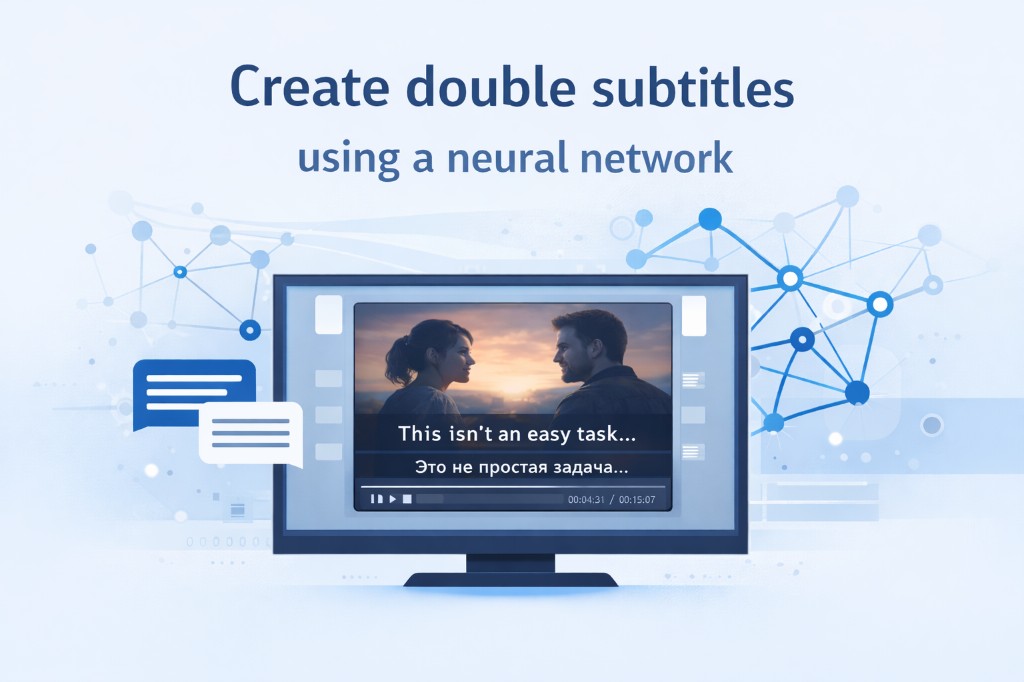
Neural networks can certainly help with automatic translation or text processing, but for the simple task of merging two subtitle tracks they are not the optimal choice. Below we look at why that is and what works better.
What Neural Networks Are Good At
Neural networks excel at tasks that require context, pattern recognition, or handling large amounts of data. They work well for translation, text generation, image recognition, and even speech synthesis. When working with text, they can take into account the meaning of phrases and sentences, which makes them very powerful.
But for tasks like merging two subtitle tracks, they are less effective. It may seem surprising, but this task does not need context or “understanding” — it only needs precise handling of timestamps and text lines.
Why Neural Networks Are Not Optimal for Merging Subtitles
Simplicity of the Task
Merging two subtitle tracks is mostly about working with text and timestamps. There is no need to understand context or model complex relationships between phrases. This can be done with scripts or even a text editor. Scripts do not require the heavy compute that neural networks do, and they do not consume tokens.
It is much faster and easier to merge subtitles online in a service like DualSubs: upload two files and get one ready-made dual subtitle file. To learn more about what dual subtitles are and why they are useful, see Dual Subtitles: What They Are and How to Watch Movies and Series.
Context Issues
Neural networks do work with context, which is useful for things like translation. However, when there is a lot of data and whole blocks of text (long phrases, different languages) are processed, the model can lose context. In those cases it may sync lines inaccurately. Simple algorithms that rely on concrete timestamps tend to work more accurately.
Accuracy and Errors
When the task is to sync two tracks in time, a neural network can make mistakes. With fast-changing dialogue or tightly packed phrases, the model may get the start and end boundaries wrong. Algorithmic methods that use exact timestamps from subtitle files (SRT, VTT, etc.) give stable, predictable results in such cases.
Bottom line: for creating dual subtitles, it is better to use dedicated tools: an online subtitle merger, scripts, or subtitle editors. They are faster, more accurate, and do not require extra resources.
Conclusion
Neural networks are powerful, but not for every task. When you only need to merge two subtitle tracks that are already in sync with the video, a neural network is not the best choice. That does not mean it cannot do the job, but it is simpler and faster to use ready-made programs or services. Neural networks are useful for translation and complex text processing; for basic subtitle operations they add an unnecessary step that slows things down and uses resources you do not need.
Need dual subtitles without AI?
Upload two subtitle files (e.g. English and Russian) and get one merged file in seconds.
Merge subtitles online