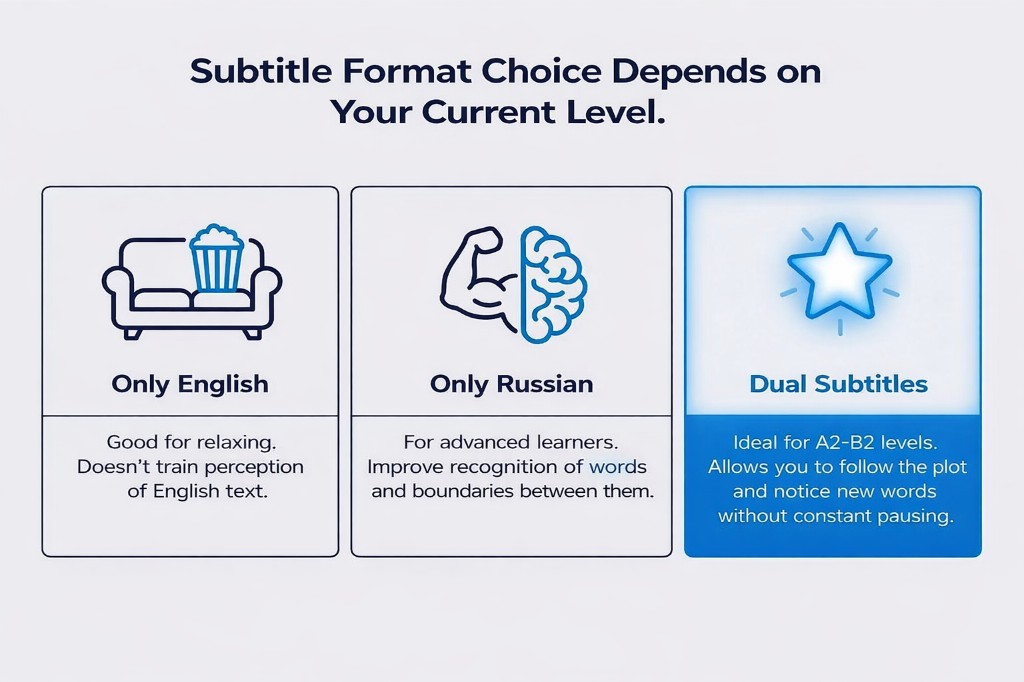
The best subtitle format depends on your level. Some learners benefit from original-language subtitles only, while others progress faster with dual subtitles for language learning, where both the original line and the translation are visible.
Why subtitles help with foreign language learning
Subtitles connect sound, spelling, and meaning at the same time. Instead of memorizing isolated word lists, you meet vocabulary inside real conversations. That makes movies and TV series one of the most engaging tools for learning a foreign language with subtitles.
- You understand natural speech and intonation more easily.
- You remember frequent words and phrases in context.
- You notice how grammar appears in real conversations.
- You can study consistently without feeling like you are doing traditional homework.
Which subtitles are best for language learning?
1. Original-language subtitles only
This works well when you already understand a fair amount of spoken dialogue. Original-language subtitles improve spelling recognition, word boundaries, and listening accuracy.
2. Translation subtitles only
Translation-only subtitles help you follow the plot, but they do less for active learning because you are not reading the target language itself.
3. Dual subtitles
Dual subtitles for language learning are often the most comfortable option for A2-B2 learners. You can keep following the story while still seeing the original line and its meaning together on screen.
Tip: if original-language subtitles alone still feel too hard, start with dual subtitles and gradually reduce your dependence on the translation.
What kind of movies with subtitles work best?
The best content for language learning usually has clear speech, common everyday vocabulary, and a storyline that is easy to follow. Familiar movies are especially helpful because you already know the context.
- Light comedies and sitcoms with everyday speech.
- TV series with short episodes and recurring vocabulary.
- Animated or family-friendly content with clearer pronunciation.
- Movies you already know well in your native language.
It is better not to start with films where the main characters speak several languages (for example, films about the Italian mafia or Mexican drug cartels): you will keep switching between English and other languages, which makes it harder to get used to English. The same applies to films where characters speak a strong regional dialect of English — at the beginning it is easier to choose content with more neutral, clear speech.
Why TV series are especially useful
TV series with subtitles for language learning are effective because you keep hearing the same characters, accents, and phrase patterns again and again. Repetition makes vocabulary and expressions easier to remember.
Series also support a better learning routine: one episode a day, a small list of useful phrases, and gradual progress without overwhelm.
How to use dual subtitles for language learning
- Choose a movie or episode with an original subtitle track and a translation.
- Merge both subtitle files into one so you can see the two lines together.
- While watching, notice repeated expressions and useful phrases.
- Save valuable vocabulary to a note-taking app or flashcards.
- Later, rewatch the same scene with only the original-language subtitles.
If you want dual subtitles for language learning, you can merge subtitles online with DualSubs and download one ready-to-use file for your movie or TV series.
A common mistake when learning with subtitles
Many learners try to translate every unknown word. That quickly becomes exhausting and takes the fun out of watching. A better strategy is to focus on overall understanding and only save words or phrases that are clearly useful or repeated several times.
How to move from dual subtitles to original-only subtitles
Dual subtitles are not the final goal. They are a stepping stone. As your comprehension improves, you can gradually remove the translation:
- watch new content with dual subtitles first;
- rewatch familiar scenes with original-language subtitles only;
- then try new content with only the original subtitles;
- and later watch selected scenes without subtitles at all.
Conclusion
Subtitles for language learning really work when used intentionally. Movies and TV series expose you to authentic speech, while dual subtitles make the learning process more comfortable and sustainable.
If you want an easy way to prepare dual subtitle files, the fastest approach is to merge the original subtitles and the translation into one track. That lets you learn through real content without extra complexity.
Want to create dual subtitles for language learning?
Upload the original subtitle file and its translation, and DualSubs will merge them into one ready-to-use file.
Merge Subtitles Online